












CodeGuard by GRCxAI · Early access

Code security that shows you exactly what it checked.

CodeGuard scans your repositories for security weaknesses, has the AI model you choose check each result against the code, and shows you exactly what each scan covered.

A separate product from the GRCxAI platform, with its own sign-in and its own billing. We set up your organisation and invite its first owner.

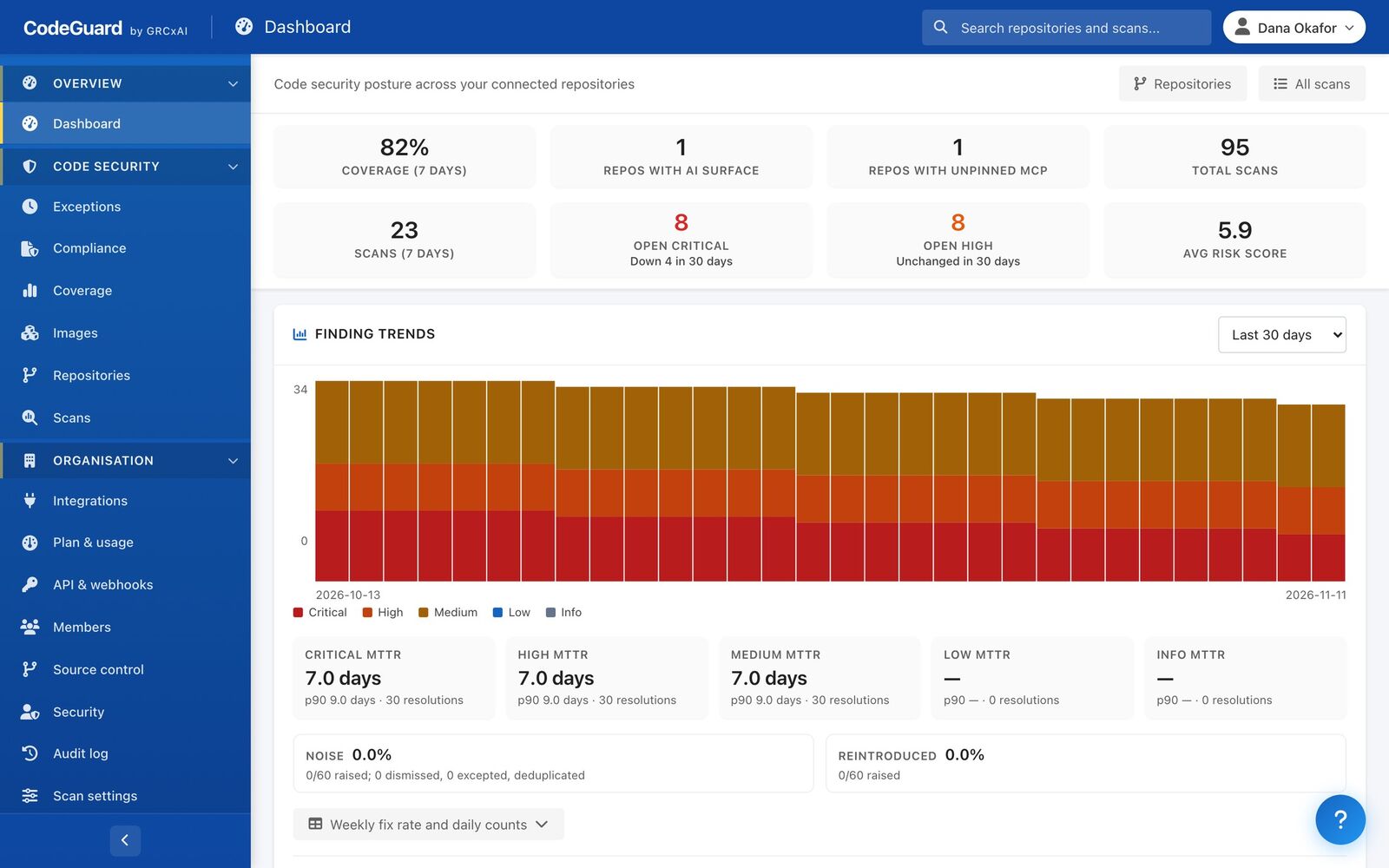
CodeGuard dashboard showing scan coverage, open critical and high findings, and a 30-day finding trend
The real application, on invented sample data.
13
Languages with code rules
400+
Code rules
7
Frameworks with evidence packs
1–5 min
A typical standard scan
Why CodeGuard

Anyone can run a one-off AI audit. The hard part is doing it every time.

That programme, with the AI you choose, is CodeGuard.

Every repository, every scan

The same rules and schedule everywhere.

Each scan shows exactly what it covered.

Fixed, and proved fixed

Your developer’s own AI agent makes the fix.

It closes only when a rescan confirms it.

Every decision on the record

Reasons, expiring exceptions and your own merge gates.

Evidence packs for 7 frameworks.

How a scan runs

Your code is read. It is never built and never run.

CodeGuard copies the repository, runs its scanners, then has a model judge the results against the code. The copy is deleted when the scan ends.

  • A one-hour token, never stored. Git hooks are disabled.
  • Scanners first, no model: secrets, dependencies, code, infrastructure, AI components, Postgres.
  • Then the AI, on your model and keys: review, report and an optional Deep Audit.
  • One risk score per finding, from CISA KEV, EPSS and reachability.
  • A software bill of materials in CycloneDX and SPDX, with VEX.
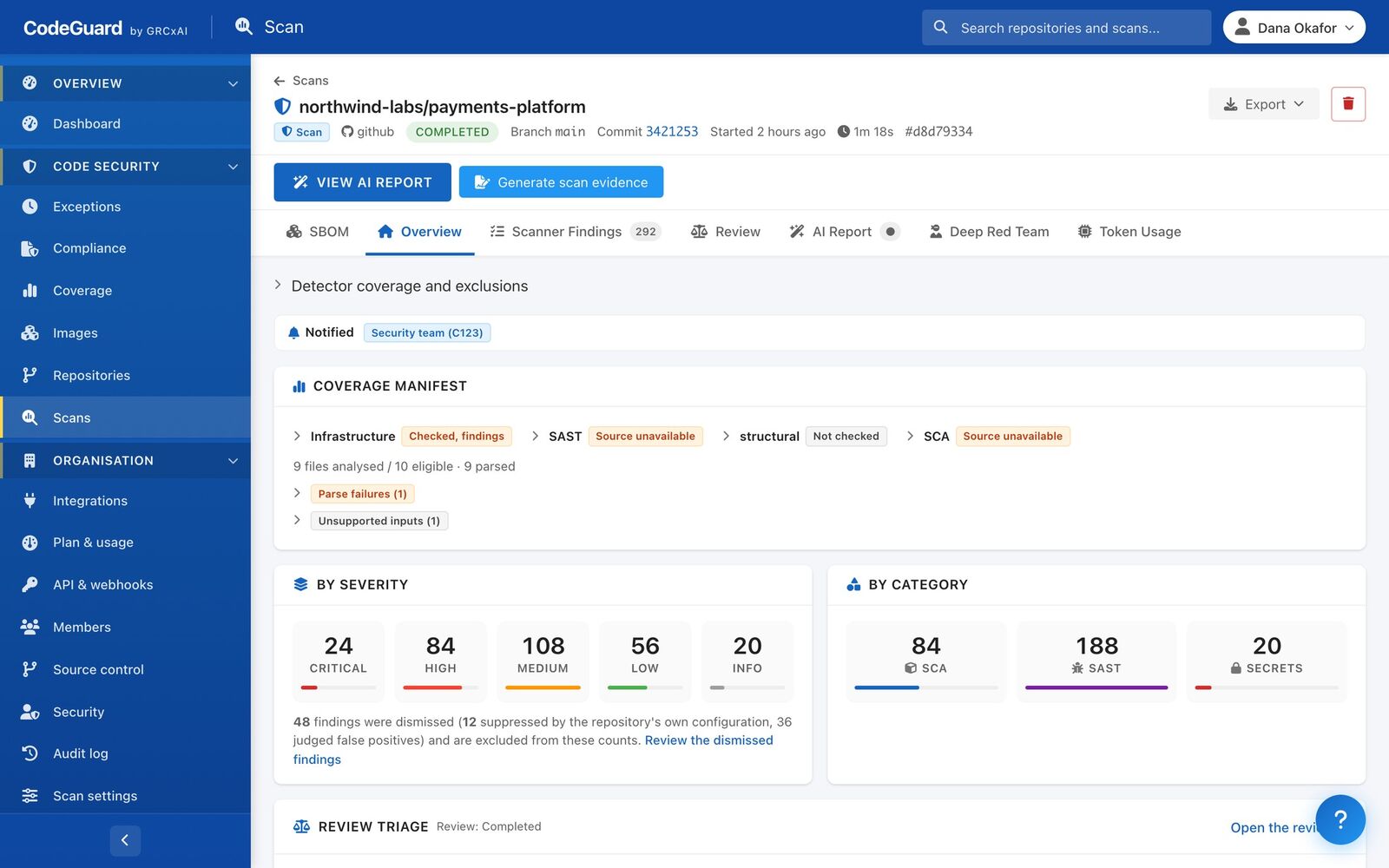
A completed CodeGuard scan: coverage manifest, findings by severity and by category
The real application, on invented sample data.
Completeness

Every scan shows you exactly what it covered.

CodeGuard’s Completeness view lists what ran in full, in part or not at all, so you always know what a result covers.

  • Unchecked is never reported as clean. A skipped stage shows as Not checked.
  • A stage that needs attention is flagged, with the reason.
  • Owners come from CODEOWNERS, so every finding has somewhere to go.
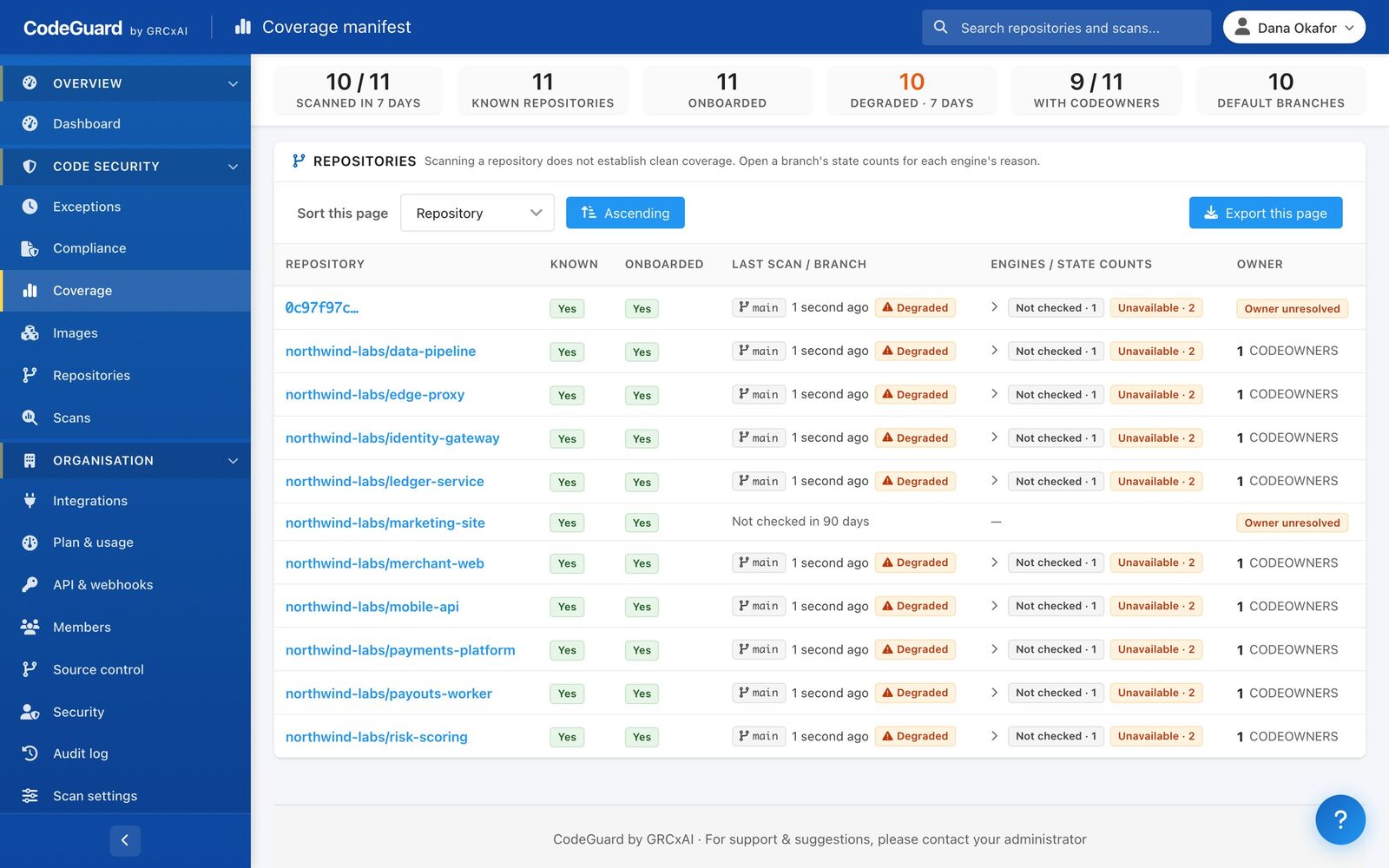
CodeGuard coverage manifest listing each repository with its last scan, degraded state and engine state counts
The real application, on invented sample data.
Findings you can check

Every AI verdict quotes the lines it relied on.

Each finding carries its severity, file and line, evidence, CVE or CWE, fix version and reachability. The AI verdict quotes the code it relied on. A dispute stays visible as a proposal for a person to decide.

  • Quotes are matched to the code. One that does not match leaves the finding open.
  • The score is explained, factor by factor.
  • Exceptions expire, with a second approver when your policy asks for one.
  • Delivered to Jira Cloud and Microsoft Teams.
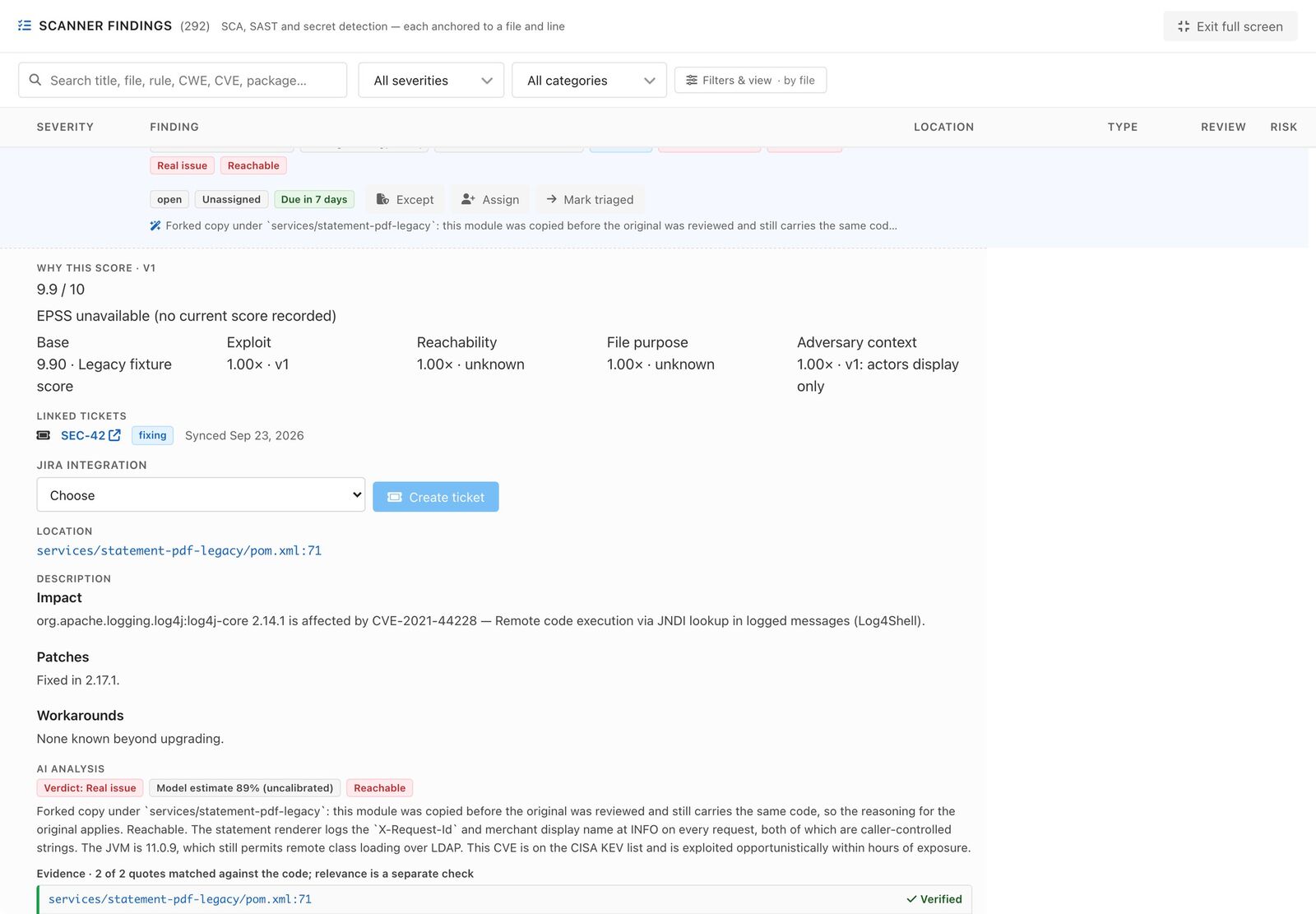
An open CodeGuard finding showing its score breakdown, location, patch version and AI analysis with verified evidence quotes
The real application, on invented sample data.
What it checks

One scan, 14 kinds of evidence.

All of these are live in production today.

Code rules (SAST)

400+ rules in 13 languages, with no AI model. Data flow followed across files in twelve languages.

Your own detection rules

Your rules run on every scan, beside ours. A broken one never switches off your pull-request checks.

Dependencies

14 ecosystems covered by advisory checks. npm aliases are checked as the packages they install.

Reachability, with the proof

Whether your code really uses it: the npm dependency path, or the Go call stack.

Malicious packages

Always critical, blocked in every pull request, and stopped before install by guard check.

Secrets

Your files and 365 days of Git history. Every credential masked before storage or AI.

Infrastructure and pipelines

300+ rules for infrastructure and pipelines, with Pod Security and host-path checks in Kubernetes.

AI components

LLM, agent and MCP code, checked against the OWASP Top 10 for LLM Applications 2026.

Postgres row-level security

Your migrations replayed, and the final schema’s row-level security judged.

Container images

Images from 5 registries, distroless and multi-platform, with Red Hat VEX.

Whole-repository AI review

Your chosen model judges each finding, quoting the code it relied on.

Deep Audit

A deeper review in several passes, with code evidence your team can check.

Licence policy

Your licence policy, applied across every dependency.

Software bill of materials

CycloneDX and SPDX with VEX, an AI bill of materials and a diff between scans.

After the scan

Evidence an auditor can follow.

CodeGuard carries each finding through policy, exceptions and gates, and assembles what an auditor asks for.

  • Fixed means fixed: closed only when a rescan confirms it; the gate, VEX and Jira follow.
  • Evidence packs for 7 frameworks include VEX summaries for the period.
  • Policy and trends: what blocks, fix deadlines, and how fast you fix.
  • Pull-request gates on GitHub, GitLab and Azure DevOps, and release gates.
  • Fix pull requests checked by your own CI, then reviewed and merged by a person. Off until you switch it on.
  • An append-only audit log of every decision.
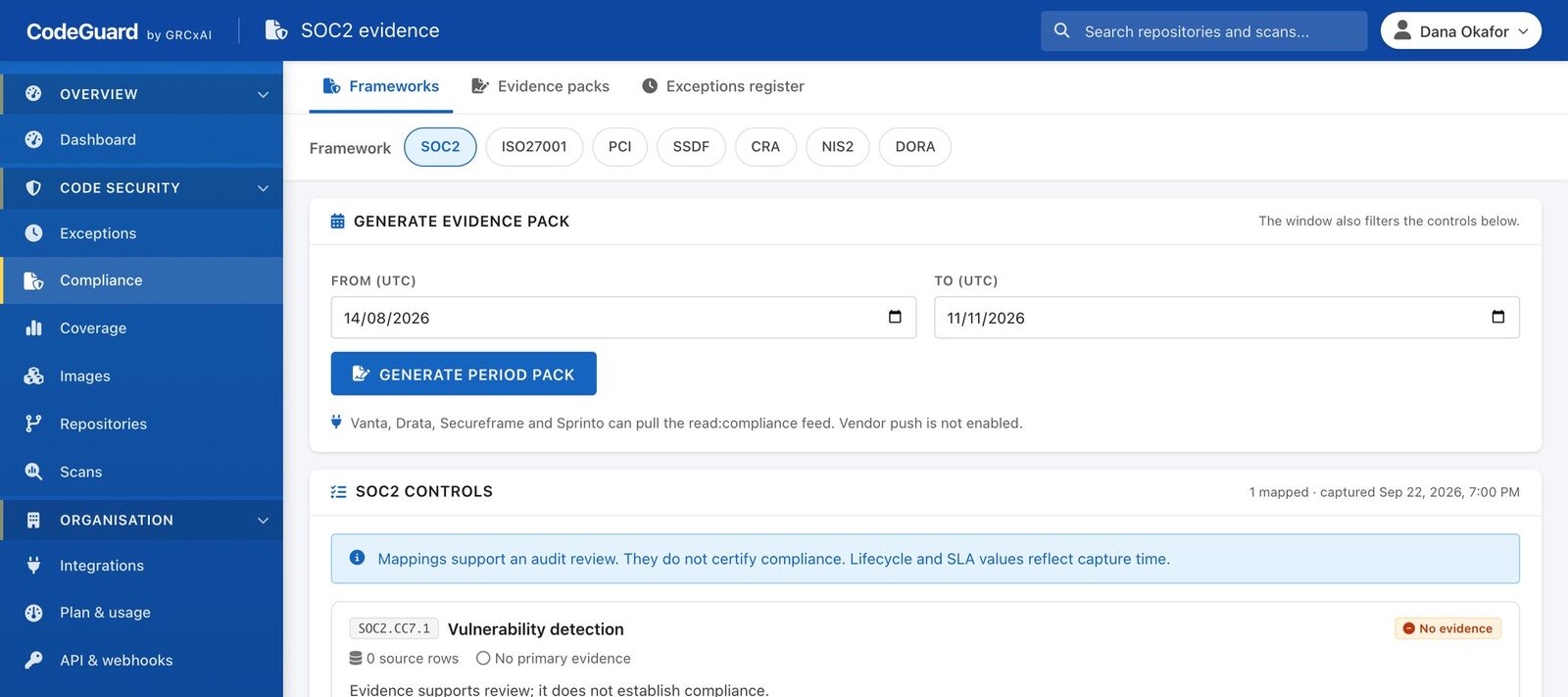
CodeGuard compliance view generating an evidence pack, with a tab for each supported framework
The real application, on invented sample data.
Built for Microsoft environments

Works where your team already works.

Repositories, sign-in, alerts and the editor. GitHub and GitLab stay fully supported.

Azure DevOps, built in

Scans, pull-request checks and inline comments.

Fix and upgrade pull requests.

Sign in with Microsoft

Entra ID single sign-on for your own domains.

Alerts in Teams and Jira

Teams cards from every scan.

Jira issues that follow the fix.

In VS Code and on desktop

Free on the VS Code Marketplace.

Desktop app for Windows and Mac. On Mac, open Change review in either app.

How the Deep Audit works

Find candidate weaknesses and check the evidence.

The desktop Deep Audit, on the model you choose.

  1. Your codeRead from a copy, never run or changed.
  2. 1. FindRead the code in scope and list candidate weaknesses.
  3. 2. JudgeA separate pass checks each candidate against the code.
  4. Each candidate ends asConfirmed with the lines it relies onSuspected shown separately for reviewRejected dropped
3 in 4
seeded flaws found
against about half for a single pass on the same model · RealVuln, 10 applications, 311 known flaws
116 / 115
flaws found, run twice
the same applications, two separate runs: almost exactly the same result
59 of 60
extra findings judged real
problems the benchmark does not list, checked blind by two other models
Measured on 10 public RealVuln applications, 5 of them never looked at while the method was built. A large repository is read in parts, so each part gets a full read, and the audit reads a private copy with the files AI coding tools treat as instructions removed, so the repository cannot steer it.
Desktop app

Run it on your own machine, with your own AI.

For signed-in members on Windows 10 or 11, 64-bit and macOS on Apple silicon. Rules and the malware index update automatically in the desktop app and VS Code. An administrator can choose manual updates.

Scans on your machine

Scanners run offline.

Deep Audit and Fix selected use your own AI tools.

Your AI, your bill

Your developer’s subscription or key, or your Microsoft Foundry.

Admins choose what is allowed.

Linked projects in CodeGuard

Results appear beside cloud scans, signed by the machine.

A project that is not linked sends nothing.

Feature matrix

Everything CodeGuard does.

Each row was checked against the product.

CapabilityAvailable todayUses an AI model
Scanners — no AI model involved
Secret scanningFiles on the scanned commit, and Git history back 365 days and up to 20,000 commits. Optional live validity checks. Every credential any scanner finds is masked before it is stored or sent to a model.YesNo
Dependency advisories14 ecosystems: npm, PyPI, Maven, NuGet, crates.io, Go, RubyGems, Packagist, Gradle, Swift Package Manager, CocoaPods, Conan, vcpkg and git submodules. A Maven POM, Gradle build (version catalogs included) or .NET project with no lockfile still has its direct versions checked against advisories, including the versions a Maven project takes from its parent POM or BOMs, such as Spring Boot’s, read from Maven Central, which receives only the parent or BOM name and version. Each finding names the version it rests on. npm aliases are checked against the installed package. Licence and release-date lookups use lighter package metadata requests. NuGet packages.config is read as the full record of what is installed.YesNo
Malicious-package detectionAlways on and raised as critical. Every pull request with one is blocked, whether it adds it or the base branch already has it, and a new one always alerts your routes. New malicious-package records, including those that name a range of versions, are matched against your repositories every 15 minutes, so a repository that already uses one is rescanned and you are alerted without waiting for your next scan. Only an administrator other than the requester can approve an exception.YesNo
Daily re-check of stored inventoriesNew advisories are matched against what earlier scans found.YesNo
Reachability, with the proofnpm: the dependency path, and development-only packages. Go: the call stack to the vulnerable function.YesNo
Code rules (SAST)13 languages, 400+ rules. Data flow followed across files in twelve languages.YesNo
Your own detection rulesOrganisation, Detection rules: run on every scan, beside CodeGuard’s.YesNo
Infrastructure and CI/CD checks300+ infrastructure-as-code rules: Terraform (AWS, Azure, Google Cloud), Azure ARM, CloudFormation, Kubernetes, Helm, Dockerfile and Compose. The Kubernetes pack added 23 rules for RBAC, exposure and Pod Security, alongside stronger host-path checks. Helm findings link to their source templates, including charts at the repository root. Plus GitHub Actions and GitLab CI.YesNo
AI-surface checksOWASP Top 10 for LLM Applications, 2026 edition.YesNo
AI-assisted merge approvalsChecks supported approval policy files for settings that bypass a second reviewer.YesNo
Postgres schema and row-level securityRepositories with Postgres migrations.YesNo
Container image scanningGitHub Container Registry, Docker Hub, GitLab Container Registry, Google Container Registry (gcr.io) and Amazon ECR. Distroless and multi-platform images; Red Hat’s unfixed vulnerabilities from its VEX data; the distribution’s severity ahead of CVSS.YesNo
Licence policyYesNo
AI analysis — on the model you choose
Whole-repository AI reviewVerdicts with quoted evidence, matched back against the code.YesYes
AI reportWriting the report uses the model. Exporting it as HTML, Markdown, JSON or SARIF does not.YesYes
Deep AuditRuns the scanners first, then an in-depth review of the code. From £15.YesYes
Desktop app — Windows 10 or 11, 64-bit and macOS on Apple silicon
Scanners on your developers’ machinesCode rules, secrets and structural rules, offline. Nothing leaves the machine.YesNo
Deep Audit on your developer’s own AIYour developer’s own AI tools, or on a key or Microsoft Foundry your organisation provides. Finds, then judges each candidate; a single pass is the quicker option.YesYes
Fix selected, with your developer’s agentTick several findings, or fix all High findings or a whole file, in one visible session, most severe first. Each fix can run your project’s own tests. Keep or undo each change, undo or reopen the whole batch, then recheck the kept fixes.YesYes
Results in CodeGuardA linked project’s results are uploaded, signed by the machine, and appear beside the cloud scans. An admin can keep them on each machine instead.YesNo
Start and follow cloud scansYesNo
Automatic rules updatesThe desktop app and VS Code refresh rules and the malware index. An administrator can set updates to manual.YesNo
Change review on MacOpen Change review from the desktop app or VS Code to review changes since a base branch. Track uploaded results in CodeGuard.YesYes
A Deep Audit the repository cannot steerDeep Audit reads a private copy with the files AI coding tools treat as instructions removed; your checkout is never changed.YesNo
In VS Code: CodeGuard by GRCxAIFree on the Visual Studio Marketplace. Deep Audits on your developer’s own AI, with findings in the Problems panel. Apply fix for one finding, or Fix selected: tick several findings, or fix all High findings or a whole file, in one visible session, most severe first. Each fix can run your project’s own tests. Keep or undo each change, undo or reopen the whole batch, then recheck the kept fixes.YesYes
Results and evidence
Risk score per findingSeverity, known exploitation (CISA KEV), exploit likelihood (EPSS) and reachability.YesNo
Completeness viewSee what ran in full or in part and review the gaps for each scan. Projects shows never-scanned and stale (30+ days) counts.YesNo
Fixed only when a rescan confirms itA comparable rescan can confirm that the finding is fixed. The merge gate, VEX statements and Jira issue follow automatically.YesNo
Finding trendsOpen findings by severity over time, your weekly fix rate, and median and 90th-percentile time to resolve, for the date range you choose.YesNo
How each finding was resolvedEach finding page says whether it was confirmed fixed by a recheck, closed by a person, or no longer found by a later scan.YesNo
MITRE CWE on every findingThe full CWE catalogue, version 5.0: 984 weaknesses.YesNo
One Projects pageRepositories and container images in one list, filtered by criticality, environment, lifecycle and tags.YesNo
One view across web, Mac and WindowsThe same scans, in the same order, in the browser and the desktop app, each showing where it ran.YesNo
Software bill of materialsCycloneDX 1.7 and SPDX 3.0.1, with VEX, an AI bill of materials and a diff between scans.YesNo
Evidence packs for 7 frameworksSOC 2, ISO 27001, PCI, SSDF, CRA, NIS2 and DORA. Packs include VEX summaries for the selected period.YesNo
Governance
PolicyWhat blocks, warns or passes, and fix deadlines by severity.YesNo
ExceptionsWith a justification and an expiry. A member applies their own, recorded as self-approved; turn on a second approver for segregation of duties. VS Code identifies dismissals awaiting administrator approval. Evidence packs retain the approval record.YesNo
Audit logAppend-only.YesNo
Token usage viewThe cost of every model call.YesNo
AI sourcesOwners and admins choose which of six ways the AI may run, and can limit each person.YesNo
Sign in with Microsoft Entra ID, SAML 2.0 or OpenID ConnectEnterprise sign-in for your verified domains, set up with your own admins. Password with an authenticator app is the default.YesNo
Workflow and integrations
GitHub App and GitLab connectionGitLab.com, or a self-managed instance reachable over HTTPS.YesNo
Azure DevOps repositoriesConnect with your own Entra app registration, scan, pull-request status and inline comments, fix and upgrade PRs.YesNo
Large repositories and monoreposUp to 8 GB and a million files in each checkout.YesNo
Very large scansThe findings list supports up to 25,000 rows. Server-generated JSON and SARIF exports carry the full results.YesNo
Scan a public repository by URLNo connection needed, so a new organisation can try it first.YesNo
Pull-request scans and merge gateOn by default for a new organisation, once the GitHub App is installed or GitLab is connected. An admin can switch pull-request scans off in Scan settings. On Azure DevOps, pull-request scans start once you add the service hook described in the setup steps. The gate uses no model; the scan’s AI stages do when they are switched on.YesGate: no
Release gatesYesNo
Draft fix pull requestsOff by default. A proposed fix is offered only after your own CI passes on it; it is never built on our servers, and a person still reviews and merges it.OptionalYes
Dependency-upgrade pull requestsOff by default. npm, PyPI, Go, crates.io and Maven.OptionalNo
Base-image recommendations, and a pull request for the FROM lineRecommendations on every image scan. The pull request is off by default.OptionalNo
Findings in GitHub’s Security tabA SARIF export with rule severities that GitHub code scanning ranks. A CodeGuard GitHub Action is published.YesNo
Jira Cloud and Microsoft Teams deliveryJira Cloud both ways: an issue for each finding, and its status follows the fix. Teams through Teams Workflows.YesNo
Change review from the command linecodeguard review-changes reviews what changed since your base branch with your developer’s own AI tools, and CodeGuard checks each finding against the code. With --upload the findings land in CodeGuard and are tracked from run to run. Mac and Linux.YesYes
Malicious packages stopped before installcodeguard guard check looks up every package your lockfiles pin in CodeGuard’s signed malware index before anything is installed, on your developer’s machine or in CI. No sign-in, and no package name leaves the machine. Mac, Windows and Linux.YesNo
REST API with tokensYesNo

Checked on 25 November 2026. “Optional” means off until one of your admins switches it on.

13 languages, and what each one gets

Code rules and dependency checks run with no model involved. The AI review and Deep Audit read every language listed.

LanguageCode rulesDependencies checked fromAI review and Deep Audit
PythonYesPyPIYes
TypeScriptYesnpmYes
JavaScriptYesnpmYes
JavaYesMavenYes
ScalaYesMavenYes
GoYesGo modulesYes
C#YesNuGetYes
RustYes — axum, actix-web, Rocket and warpcrates.ioYes
C and C++Yes — unsafe functions, string and off-by-one errors, command injectionConan, vcpkg and git submodulesYes
PHPYes — plain PHP, Laravel, WordPress, Symfony and CodeIgniterPackagistYes
RubyYes — Rails, Sinatra, Grape and RackRubyGemsYes
KotlinYes — Android, Spring and KtorGradle lockfileRead as text
SwiftYes — iOS apps and VaporSwift Package Manager and CocoaPodsRead as text

CodeGuard ships only rules it may use in a paid service.

Pricing

One platform fee for your team. Usage on prepaid credit or your own keys.

In pounds sterling, by card through Stripe only: a monthly subscription and prepaid top-ups. No invoices or purchase orders. The scanners cost nothing per scan. On your own keys, your AI provider bills you for the model directly.

Platform fee
£500/month

Includes 10 named users. Each extra named user is £50 a month.

  • Unlimited deterministic scanning: code, dependencies, secrets, infrastructure, containers and Postgres.
  • First month free, from when your first card is added.
  • AI model scans are funded separately, from the usage credit you add.
Usage
from £15 per Deep Audit

Cloud scans use your organisation’s own provider keys by default, or your Microsoft Foundry. CodeGuard adds nothing per token on your keys.

  • Choose the AI option in CodeGuard before you start the scan.
  • A Deep Audit is charged from £15, from prepaid credit: top-ups of £50 to £5,000.
  • Desktop audits run on your developers’ own AI tools, or on keys you provide.
  • The Token Usage view shows the cost of every model call.
  • Credit lasts 12 months and is not refundable. No VAT is added.

Legal: CodeGuard Terms of Service · DPA · Subprocessors. CodeGuard is offered worldwide to businesses; the DPA covers UK, EU, Swiss and US state privacy law.

Your code

Where your code goes, exactly.

The question a security team asks first, answered here.

Runs in Germany

Our own server, behind Cloudflare, with no inbound connections.

Organisations kept apart by the database itself.

Findings kept, clone deleted

Findings, evidence excerpts and reports, until you delete the scan.

The copy of your repository is deleted when the scan ends.

Secrets masked for the model

Only the code under review goes to the AI provider you choose.

AI analysis off: no code is sent.

Public lookups, no code

Package names and versions, to public advisory sources and registries.

Optional key checks call only the issuing provider.

CodeGuard’s own Terms, DPA and subprocessor list. The DPA covers any processing outside the UK and the EEA.

CodeGuard questions

CodeGuard is in early access. We create your organisation and invite its first owner by e-mail; everyone else joins by invitation from one of your admins. An invitation is accepted in one click, and a public repository can be scanned by its URL before you connect GitHub, GitLab or Azure DevOps.

Book a walkthrough and we will set you up from there.

No. CodeGuard is a separate product with its own sign-in, its own database and its own billing. It does not require a GRCxAI subscription. CodeGuard is sold on its own, and can also be added to a GRCxAI agreement by Order Form.

CodeGuard’s own: the Terms of Service, the Data Processing Agreement and the subprocessor list. They are accepted when you join, and existing users accept them once at their next sign-in. If your organisation has signed an Order Form that expressly includes CodeGuard under the GRCxAI Master Subscription Agreement, that agreement applies instead.

GitHub, through a GitHub App that you install on the repositories you choose, and GitLab — GitLab.com, or a self-managed instance that is reachable over HTTPS. Azure DevOps repositories: connect with your own Entra app registration, scan, pull-request status and inline comments, fix and upgrade PRs.

Yes. Switch AI analysis off and a scan runs the scanners only: no code is sent to a model provider and nothing is charged. The AI review, the AI report and Deep Audit scans run when AI analysis is on. The desktop app’s scanners also run with no AI at all.

Yes. The desktop app for Windows 10 or 11, 64-bit and macOS on Apple silicon runs the scanners offline and the Deep Audit on your developer’s own AI tools. A linked project’s results appear in CodeGuard beside the cloud scans, unless an admin keeps desktop results on each machine.

A standard scan usually takes one to five minutes, plus the report. A Deep Audit typically takes ten to sixty minutes. A larger repository takes longer.

It means the checks that ran found nothing, and the Completeness view shows exactly which checks those were. Every AI verdict carries the lines of code it relied on, so someone who knows the code can confirm it before acting.

Every figure on this page was checked against the product on .

See it on one of your own repositories.

A walkthrough of the live product, then an organisation of your own to try it in.